
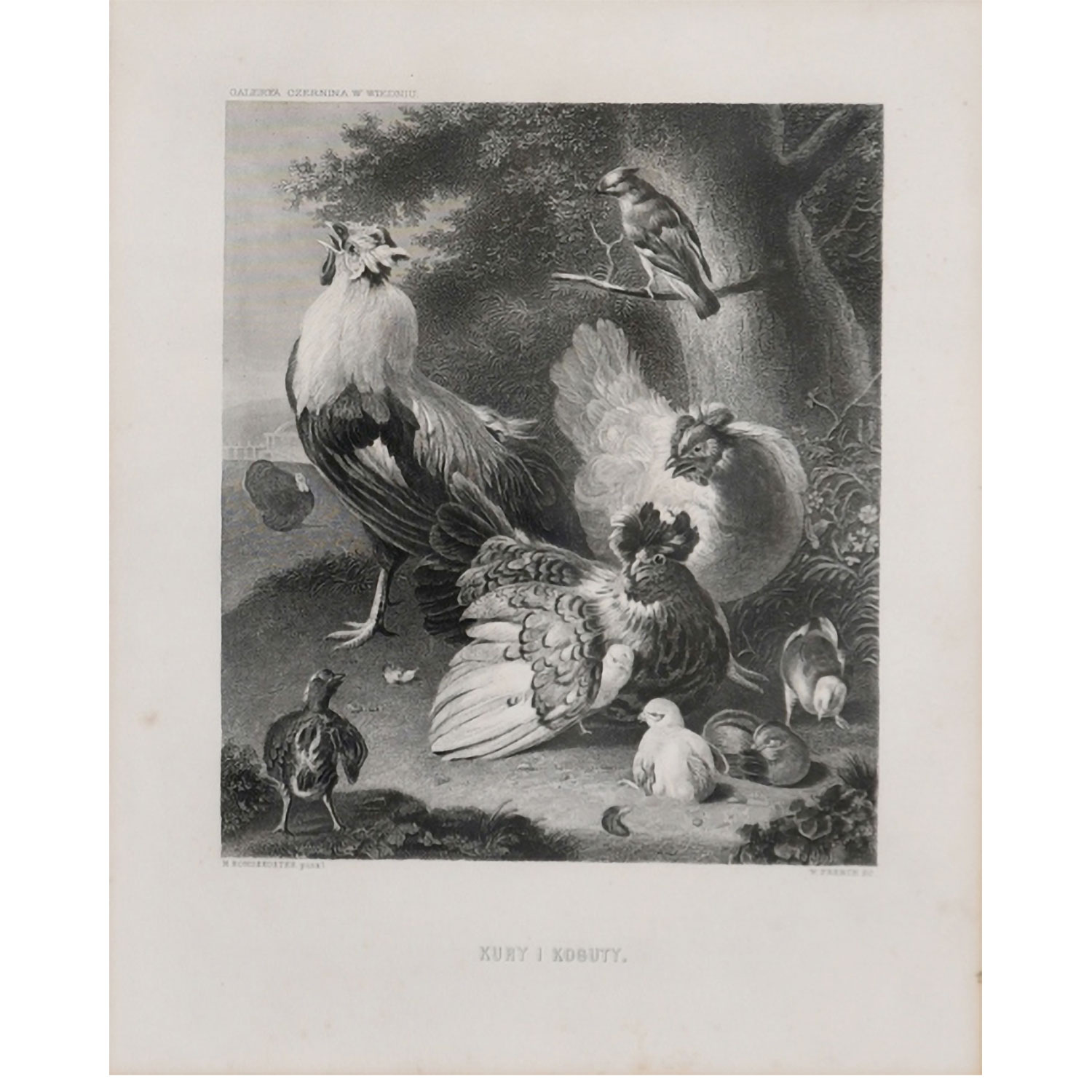
d’Hondecoeter M. – Hens and Roosters
1909 / dry needle technique / 18×15 cm
Who was Melchior d’Hondecoeter?
He was born in 1636 in Utrecht (Netherlands), and died on April 3, 1695 in Amsterdam.
He was the most famous Dutch animalier painter, with a special focus on birds – wild and exotic – which he depicted in rich, often park scenes.
Family artistic heritage
He came from a family of painters – grandson of Gillis d’Hondecoeter (landscape painter), son of Gijsbert (animal and insect painter), and nephew of painter Jan Baptist Weenix.
Training: first with his father, and after his death with his uncle Weenix.
Career and style
In 1659 he became a member of the Confrerie Pictura painting academy in The Hague.
In 1663 he moved to Amsterdam, where he lived until his death. He married Susanne Tradel; they had two sons, baptized in 1666 and 1668.
He often depicted birds at the edges of the canvas, such as gulls, peacocks, and even cassowaries and African cranes, in stylized landscapes of castles and parks, inspired by the works of Frans Snyders.
He was extremely prolific: more than 200 works are now attributed to him.
He was humorously called the “Phoenix of his art” (Arnold Houbraken).
Most famous works and collections
The Floating Feather (A Pelican and Other Birds Near a Pool, c. 1680) – a masterpiece, known for its realistic depiction of plumage with floating feathers.
The works are in numerous museums around the world: The Hague, Soestdijk, Amsterdam (Rijksmuseum), then in Berlin, London, Paris, Warsaw and other cities.
In Poland, specifically in the Lazienki Royal Park in Warsaw, a painting by Melchior is kept: Hens and Chickens, Pheasant and Peacocks – another name and the attribution is not disputed.
Legacy and significance
His focus on birds as living beings, not just decorative accessories, was innovative. Compared to his father and predecessors, he depicts them as the main subject of the composition.
He stylized the environment with architecture and landscapes — often Italianate — instead of rustic farms, which gave the works a grandiose quality.
His works were in great demand among the wealthy Dutch and the duchy (Stadholder), especially William III.
A major exhibition in Berlin (2010) presented 18 of his works as part of the exhibition “Intolerance”.
